At speeds over 50 km/h, the trot won’t hold on its own: each diagonal must remain perfectly synchronized, or the horse will lose its rhythm within a few strides. Over 1,609 meters covered in 1 minute and 50 seconds, the driver therefore has almost no time to correct any imbalance that develops. His role is not to pull on the reins, but to sense when the horse tenses up, shortens its stride, or loses its rhythm. An overly abrupt correction would often have the opposite effect: it would halt the gait and further increase the risk of the horse breaking stride. After an exciting harness trotting race, 1xBet Casino offers another way to have fun with a wide variety of games.
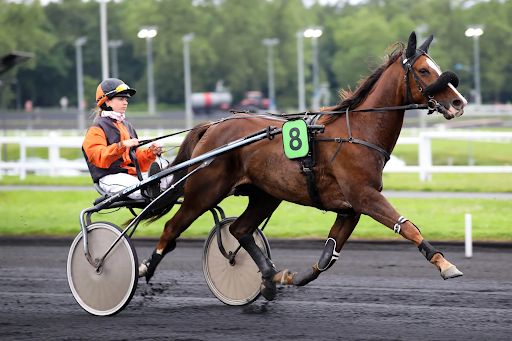
Loss of coordination often occurs when the stallion accelerates too abruptly, enters a turn with poor balance, or begins to tire in the final 300 meters. The driver then monitors the horse’s head position, the cadence of its legs, the movement of its shoulders, and the vibrations transmitted through the two reins. Even the slightest change in contact can signal that the horse is shortening a diagonal stride or beginning to strike its own legs. Once the races are over, 1xBet Casino offers a wide selection of slot machines and casino games.
How the reins, the path, and the rhythm stabilize a horse’s trot
The driver generally maintains even pressure on both reins to keep the horse’s head and neck aligned with the sulky. When turning, the driver gently guides the stallion in the direction of the turn with the inside rein while using the outside rein for support, without pulling the horse’s mouth toward the center of the track. On a 1,000-meter track, the wider turns allow for a relatively smooth cadence, whereas a half-mile track approximately 805 meters requires greater balance. The tighter the turn, the more the driver must avoid sudden acceleration that would shift the horse’s weight outward.
The main methods used to maintain a good stride are as follows:
- Consistent contact on both reins.
- Gradual acceleration over 100 or 200 meters.
- Quarter-mile times of around 27 to 30 seconds.
- Outside support in tight turns.
- Stable sulky position behind the hips.
- Constant monitoring of the diagonal stride.
Position in the pack also affects the stallion’s stability. A trotter boxed in behind two rivals may tense up when it lacks space, whereas a horse on the outside must exert more effort against the air.



















Follow us on Instagram